SAP ODP: Why the restriction on ODP-RFC is not a risk – but rather confirms our approach

SAP ODP (Operational Data Provisioning) has been one of the best-known technologies for providing and replicating SAP data for years. It enables both full and delta transfers and uses technical mechanisms such as the Operational Delta Queue to efficiently provide changes. As a result, the SAP ODP Data Replication APIs (ODP-RFC) has long been used as the standard for integrating SAP data into analytical target systems.
Accordingly, there was significant attention when SAP explicitly restricted the use of certain SAP ODP Data Replication APIs by third-party applications. The focus here is particularly on SAP Note 3255746. Access to these interfaces outside the SAP ecosystem is therefore considered non-compliant and may lead to risks regarding support, licensing, and audit.
For many organizations, this immediately raises the question of what impact this clarification has on existing SAP ODP-based data integrations. While numerous solutions are now under pressure to adapt, another perspective is emerging at the same time: for modern, cleanly developed architectures, this change has no negative impact whatsoever – quite the opposite.
Because the restrictions of ODP-RFC confirms exactly the path that SAP has been defining for years with its Clean Core strategy.
No impact on modern data integration – even without ODP-RFC
The key takeaway is this: the restriction on the SAP ODP Data Replication APIs affects only approaches that are based precisely on these mechanisms. Solutions that have relied from the outset on alternative, approved, and standardized methods are not affected. This is exactly where the difference lies between integrations that work in the short term and truly future-proof architectures.
With dab Nexus, this difference is particularly clear. The solution was deliberately not built on the now prohibited ODP-RFC access methods, but instead uses only SAP-compliant mechanisms and standardized interfaces.
Specifically, this means:
- The restriction on the SAP ODP APIs has no impact on dab Nexus.
- While other providers have to adapt their products, dab Nexus remains unaffected and fully functional.
Future-proofing through conscious architecture decisions
This stability is no coincidence, but the result of a clear architectural approach. Modern SAP data integration must not depend on individual technical access paths, but must be designed in such a way that it continues to function even when framework conditions change.
That is exactly the case here. dab Nexus continues to enable high-performance, scalable, and automated data integration from SAP systems. For customers, this means one thing above all: future-proofing.
Clean Core as the foundation for sustainable data integration
A key reason for this is the consistent alignment with SAP’s Clean Core strategy. This approach requires all integrations to use official, supported mechanisms while leaving the SAP core untouched. dab Nexus meets these requirements. The solution is Clean Core Compliant at Level B and therefore follows exactly the guidelines that SAP itself specifies.
In addition, this approach goes one decisive step further: With the Clean Core Level B certification, SAP confirms that the underlying architecture is also designed for future releases and will be supported in the long term.
Technological advantage with dab: Real-time capability without SAP ODP-RFC
A central aspect of data integration is the provision of delta information, in other words, the identification of data changes. Instead of relying on the affected SAP ODP Data Replication APIs or unsupported methods, dab Nexus uses its own intelligent mechanisms for detecting data changes. These take into account, among other things, business logic, dependencies between tables, number ranges, change tables, and other technical characteristics.
This allows data changes to be reliably identified without making adjustments to the SAP system or relying on restricted interfaces.
The result is powerful data integration that:
- can process high data volumes
- enables real-time replication
- requires no adjustments in the SAP system
- is fully aligned with SAP guidelines
Transparency and verifiability as the new standard
With SAP Note 3439624, an additional aspect comes into play: the ability to actively check data access and demonstrate compliance. For companies, this means that they must not only implement their data integration in a compliant manner, but also be able to document it transparently.
For dab Nexus, this is a clear advantage. Since the solution does not use APIs that are no longer supported, compliance with SAP guidelines can also be clearly verified in the corresponding checks. Compliance thus moves from a theoretical requirement to a measurable state.
The attached screenshots clearly show what a compliant report looks like when dab Nexus is used as a tool for SAP data integration. The evaluation clearly shows that no unauthorized access to SAP ODP Data Replication APIs takes place and that all checks are completed without any findings.
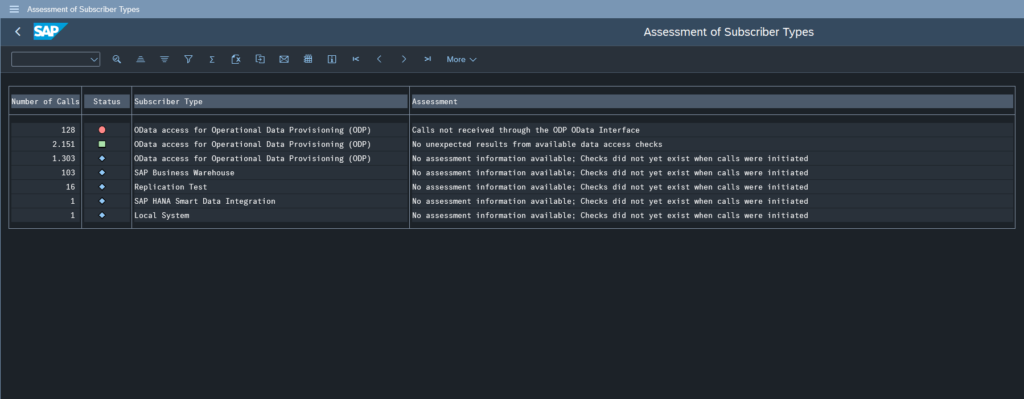
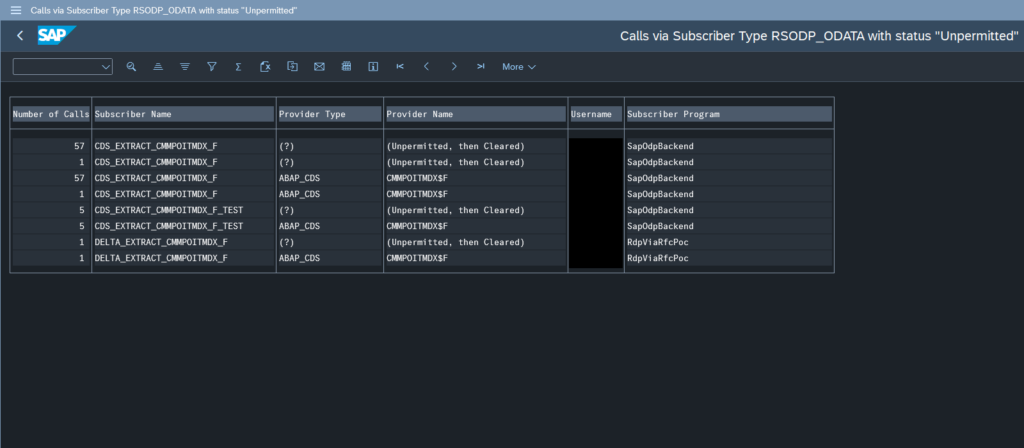
This transparency is crucial: companies can not only ensure that their data integration is compliant, but can also prove this at any time in a traceable and reliable manner.
Would you like to see for yourself?
Test dab Nexus with no obligation in a proof of concept and experience the performance, compliance, and future-proofing of your SAP data integration under real-world conditions – without any financial risk.
Content Listing
Share This Article