Explainable Process Mining: KIGA wrap-up – from research to grounded AI explanations


Explainable Process Mining helps organizations make complex process analyses based on SAP event logs transparent, understandable, and actionable. This is exactly where the BayVFP research project KIGA comes in: it demonstrates how Process Mining, explainable AI (XAI), and generative AI can be combined to better explain data-driven decisions and enable more informed analysis of business processes.
SAP processes generate a lot of valuable data. But turning that data into trusted process decisions is not always straightforward. Event logs can contain many variants, exceptions, loops, skipped steps, and deviations. Process Mining helps make these patterns visible. Yet when the result is a dense process model, the next challenge begins: how can business users, process owners, and analysts understand what they are seeing?
This question shaped the KIGA research project over the past several years. The project investigated how explainable Process Mining can enhance process analysis by making it more transparent, explainable, and easier to apply in practice. For dab, this topic directly connects to our work with enterprise data, SAP event logs, analytics, auditability, and business process improvement. KIGA provided us with the opportunity to explore new methods at the intersection of Process Mining, explainable AI, semantic event data, and generative AI for Process Mining.
KIGA at a glance
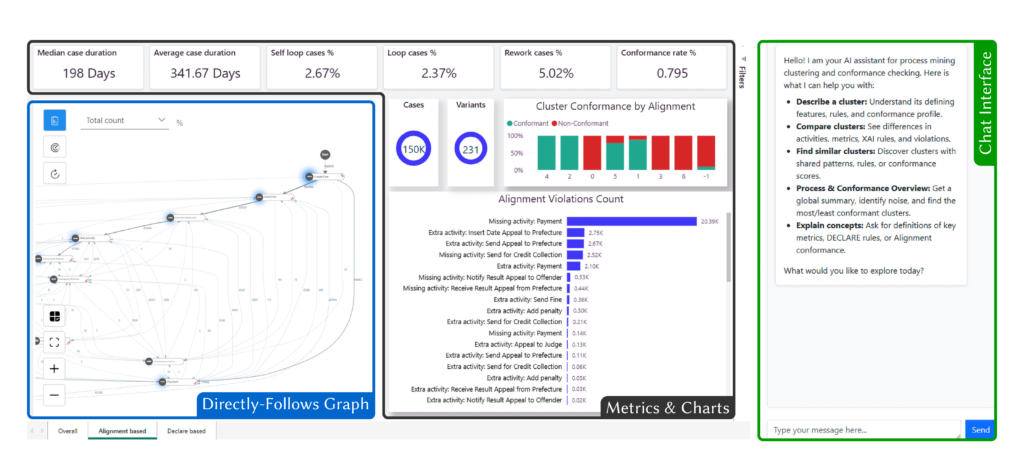
KIGA focused on one central goal: making complex Process Mining results easier to understand and verify. The project explored how to enrich event logs with additional process knowledge, how to group similar process executions into meaningful clusters, and how to explain these clusters in a way that supports human analysis. The latest demonstrator brings these ideas together in an interactive dashboard. It combines Process Mining, explainable clustering, conformance checking, and an LLM-based chat interface that uses defined function calls instead of free-form guessing.
From complex event logs to understandable process insights
At the beginning of KIGA, the main problem was already clear: Process Mining often produces models that are technically correct but difficult to interpret.

A process model may show hundreds of variants. It may reveal rework, missing activities, unusual paths, and deviations from an expected process flow. For a Process Mining expert, this can already be a significant challenge. For business users, auditors, or process owners, it can be even more challenging to determine what matters.
The project, therefore, focused on three connected ideas:
- Enriching event logs with additional semantic information
- Identifying meaningful subprocesses through clustering
- Explaining these clusters in a way that people can understand and verify
One important research direction was the semantic event log. In simple terms, this means adding more context to raw event data. Instead of only looking at which activity follows another, the event log can include additional rule-based information about the order and meaning of process steps. This creates a better foundation for explainable Process Mining. The goal is not only to discover a process model, but to understand why certain process instances belong together, how they differ from others, and where deviations occur.
Why explainability matters in Process Mining
Process Mining is often used to support decisions in areas such as accounting, procurement, compliance, risk, operations, and business intelligence. In these contexts, transparency matters. If a dashboard shows that a group of cases behaves differently, users need to know why. If a process variant has many deviations, users need to see which activities or rules are involved. If an AI-supported assistant explains a process pattern, users should be able to trace the answer back to the underlying data.
This is especially relevant for SAP-based process analysis. SAP systems contain highly structured business data, but process behavior still needs to be reconstructed from events, timestamps, activities, documents, and master data. Without clear explanations, process mining results can remain too technical for the people who could benefit from them most.
KIGA addressed this gap by combining Process Mining with explainable AI methods. The research explored how clusters of process instances can be described with rules, how deviations can be summarized, and how technical results can be translated into understandable language.
How generative AI changed the direction of the project
When KIGA started, the focus was mainly on semantic methods, clustering, and explainable process models. During the project, generative AI and Large Language Models became much more widely available. This changed what was possible. The project did not simply replace process analysis with an LLM. That would not be reliable enough for enterprise analytics. Large Language Models can produce fluent text, but they are not dependable on their own when they need to reason over numerical data, process structures, rankings, or conformance results.
Instead, the research direction moved toward a more controlled approach: using generative AI for Process Mining as an interface for explanation, while keeping the analytical results grounded in computed Process Mining and XAI outputs.
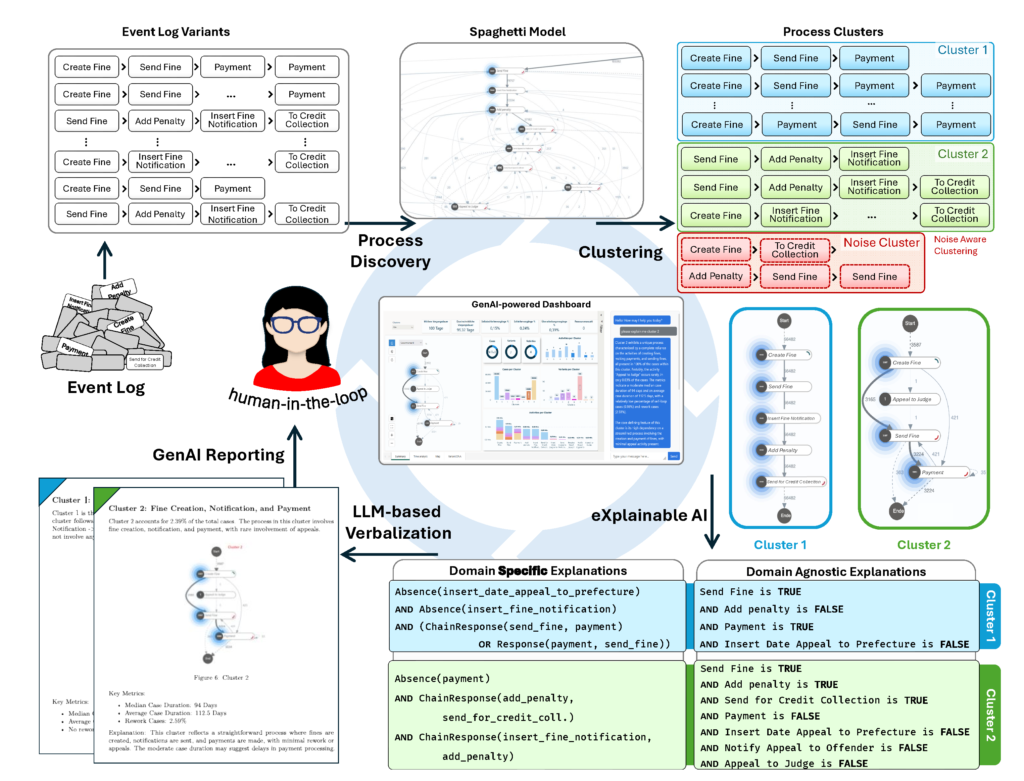
This distinction is important. In the KIGA demonstrators, the LLM is not the component that decides what the process means. The Process Mining, clustering, conformance checking, and explanation methods compute the relevant results. The LLM helps users access and understand these results in natural language.
From retrieval to agentic AI for Process Mining
An earlier demonstrator explored how process clusters and their explanations could be made more accessible through an interactive dashboard and generative AI support. This work combined clustering, rule-based explanations, and a Power BI-based user interface using Retrieval Augmented Generation (RAG).
The latest demonstrator takes the next step. It moves toward agentic AI for Process Mining through controlled function calling and includes comparing a process against a normative process model (conformance checking). In simple terms, this means that the agent receives a defined set of tools. These tools can retrieve metrics, compare clusters, find similarities, explain rule types, and access conformance information. When a user asks a question, the agent selects the required functions, calls them, and uses the returned data to formulate an answer.
This approach helps reduce the risk of ungrounded explanations. The agent is not expected to invent an interpretation. It works with values, rules, and explanations produced by the underlying analysis pipeline. For enterprise users, this is a practical step toward more transparent AI-assisted analytics. A process owner can ask a natural-language question, while the answer remains connected to verifiable process data.
What this means for SAP process teams
For SAP process teams, the practical value lies in making complex process data easier to discuss. Instead of only looking at a large process model, users can focus on specific clusters, deviations, or rules. They can compare subprocesses, ask why a group of cases behaves differently, and inspect the data behind an explanation. This can support better conversations between business users, analysts, IT teams, and audit stakeholders. The aim is not to automate expert judgment. The aim is to make process insights more transparent, structured, and easier to validate.
For organizations working with SAP event logs, this points toward a useful direction: process mining results should not only be visual. They should also be explainable, traceable, and connected to the business questions people actually ask.
What we learned
KIGA showed that explainable Process Mining needs more than a better visualization. Complex event logs require several layers of support: semantic enrichment, clustering, rule-based explanations, conformance checking, and user-friendly interaction.
The project also showed that generative AI is most useful when it is grounded and traceable. For process analytics, the value is not in letting an LLM freely explain a process model. The value is in connecting natural-language interaction with reliable analytical tools. This does not remove the need for expert review. The demonstrator is a research result and should be validated carefully for each practical use case. But it shows how analysts, process owners, and business users could work with complex process data in a more transparent and structured way.
Explainable Process Mining in action
The latest KIGA demonstrator is the practical showcase at the end of this research path. It presents grounded LLM-based explanations for explainable Process Mining via agentic function calling.
- Microsoft Power Automate Process Mining is used for process discovery and visual analysis.
- Power BI provides an interactive dashboard for process graphs, metrics, charts, navigation, and analysis views.
- Custom XAI components add explainable clustering and conformance checking.
- An agentic LLM interface lets users ask questions about processes, clusters, deviations, similarities, and rules.
The demonstrator uses event-log data, identifies process variants and clusters, checks conformance against a normative process model, and explains patterns in a business-readable way. It includes both alignment-based conformance checking and declarative conformance checking using rule-based process knowledge.
This makes it possible to ask questions such as:
- Why is this cluster non-conformant?
- Which deviations are most relevant for this group of cases?
- How do two clusters differ?
- Which cluster is most similar?
- Is a specific rule violation more common in one subgroup than in the overall dataset?
The dashboard also makes the agent’s tool usage transparent. Users can inspect which functions were called and what structured data was returned. This is important for trust, especially when AI is used in analytical or audit-related scenarios.The key idea is simple: AI explanations should be understandable, but they should also be grounded.
This demand for explainable and transparent Process Mining results is already reflected in applications. The dab AI Analyst builds on these principles and applies them to the analysis of SAP data: analysis results are automatically interpreted, patterns and deviations are identified, and presented in a way that makes them understandable within their business context. Combined with interactive visualizations and an integrated chat, this creates a consistent working foundation that enables business units, IT, and audit teams to analyze complex relationships transparently and engage in well-informed discussions.
Would you like to discuss how explainable Process Mining, SAP event logs, or AI-supported analytics could support your own process transparency goals? The dab team will be happy to exchange ideas.
A collaborative research effort
Finally, KIGA was a joint research effort involving dab, academic partners, students, and researchers across several institutions. The project brought together expertise in Process Mining, explainable AI, logic, knowledge representation, generative AI, network visualization, and applied enterprise analytics.
Special thanks to the project members who shaped the project over the years, including Christian Dormagen, Oleksii Kalashnikov, Andreas Fischer, Ute Schmid, Stephan Scheele, and the wider project environment. We also thank VDI/VDE and the BayVFP funding context for supporting this research work.
The project resulted in several scientific contributions around explainable clustering, semantic event data, generative AI for Process Mining, and agentic explanations. Just as importantly, it helped turn these ideas into demonstrators that show how research can connect to real enterprise analytics tooling.
Content Listing
Share This Article